
Replacing a missing tooth is an important decision. You want to understand your options, know what treatment involves, and have a clear picture of the cost before moving forward.
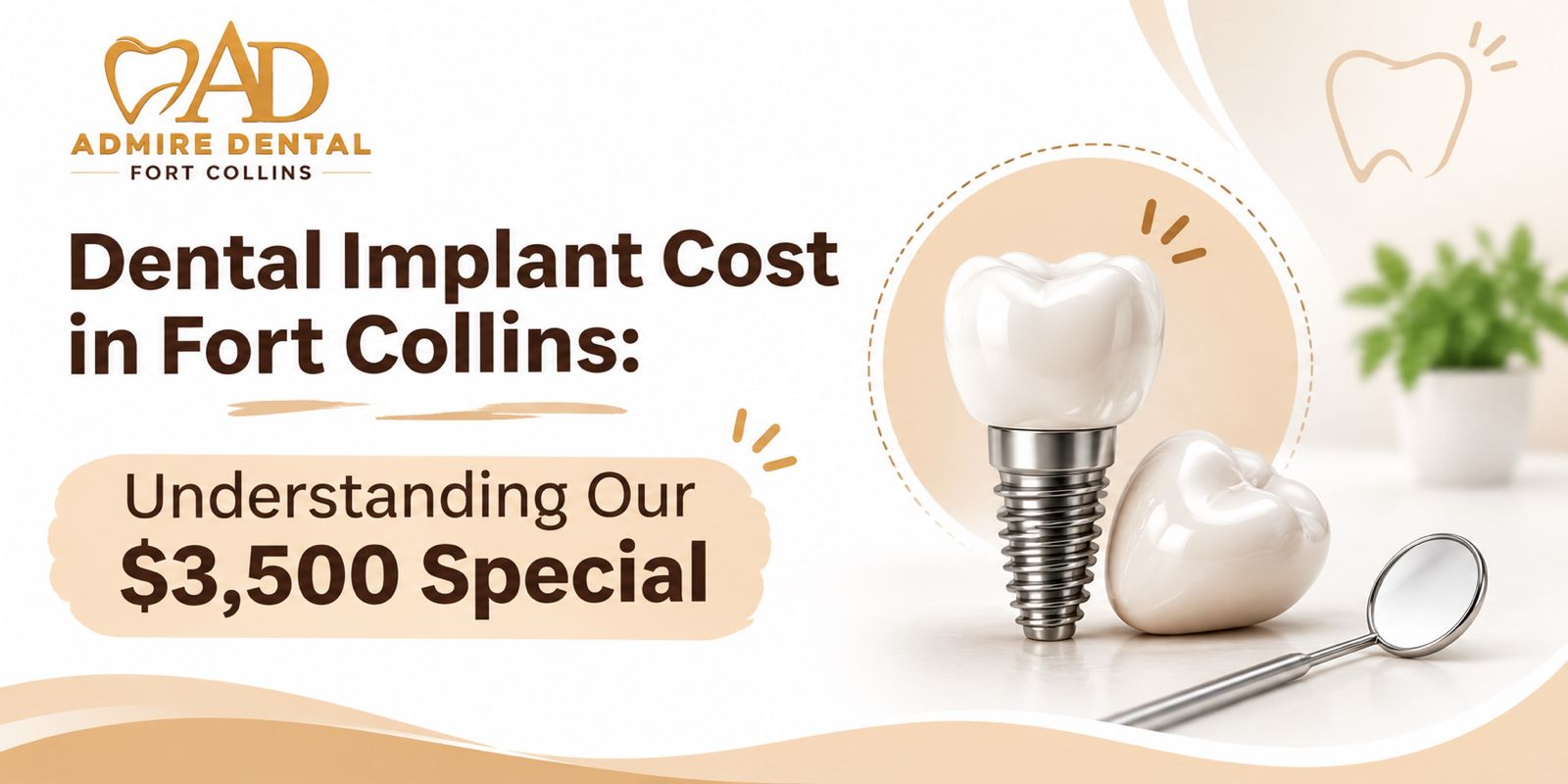
At Admire Dental Fort Collins, our $3,500 single-tooth implant special includes implant placement, the abutment, and the final crown. These are the three main components used to replace a single missing tooth with an implant.
Offer details: This is a self-pay special and does not apply when using dental insurance. An examination is required to determine whether implant treatment is appropriate. Additional services—including examinations, imaging, extractions, bone grafting, sinus augmentation, temporary teeth, or sedation—may involve separate fees. The offer applies to a single-tooth implant restoration, not full-mouth treatment.
Here’s what is included, what may affect your total cost, and what to expect during treatment.
What Is a Dental Implant?
A dental implant replaces the root of a missing tooth and supports a replacement tooth above the gumline.
A single-tooth implant restoration typically has three parts:
| Component | What it does |
| Implant | A small post placed in the jawbone to support the replacement tooth. |
| Abutment | A connector that joins the implant to the crown. |
| Crown | The visible replacement tooth, made to fit your bite and blend with your smile. |
Together, these components provide a fixed tooth-replacement option that does not rely on neighboring teeth for support.
What Does the $3,500 Implant Special Include?
Our $3,500 self-pay special includes:
- Placement of one dental implant.
- The abutment connecting the implant to the crown.
- The final implant crown.
Your examination will help determine whether you need additional procedures before or during implant treatment. Your individualized estimate should identify those services and their fees.
The $3,500 special cannot be used when using dental insurance. If you choose to use insurance, standard office fees and your plan’s benefits apply.
What Could Affect My Total Treatment Cost?
Every mouth is different. Some patients are ready for implant placement after their evaluation, while others need preparatory care.
Additional treatment or services may include:
Tooth Extraction
If a damaged tooth is still present, it may need to be removed before an implant can be placed. Whether tooth extraction and implant placement can happen at the same appointment depends on the condition of the area.
Bone Grafting
An implant needs adequate supporting bone. If the bone has changed following tooth loss or disease, grafting may be recommended before or at the time of placement.
Sinus Augmentation
For certain upper back teeth, the location of the sinus and available bone may require an additional procedure before implant placement.
Examinations and Imaging
An examination and appropriate imaging help your dentist evaluate the area and plan treatment. Depending on your needs, this may include X-rays or three-dimensional imaging.
Gum Treatment
Healthy gums are important for implant care. Existing gum disease may need to be addressed before proceeding.
Temporary Tooth Replacement
A temporary replacement may be an option during healing. Its suitability and cost depend on the treatment plan.
These services are not necessary for every patient. Your dentist will explain which procedures are recommended for you and why.
Am I a Candidate for a Dental Implant?
A dental implant may be an option if you are missing a tooth or have a tooth that cannot be restored. An individual evaluation is necessary to determine whether it is appropriate.
Your dentist will consider:
- The health of your gums and surrounding teeth.
- The amount and condition of supporting bone.
- Your medical history and medications.
- Tobacco use and other factors that may affect healing.
- Your bite and the location of the missing tooth.
- Your ability to maintain the implant with daily cleaning and regular visits.
Some patients need additional treatment before receiving an implant. Others may be better suited to a bridge or removable partial denture.
What Happens During Implant Treatment?
Treatment is planned around your individual needs, but the process generally includes the following stages.
1. Evaluation and Treatment Planning
Your dentist examines your mouth, reviews your health history, and obtains appropriate imaging. You discuss suitable treatment options, anticipated costs, and the expected timeline.
2. Preparatory Treatment, If Needed
An extraction, bone graft, or gum treatment may be necessary. Some procedures can be completed together; others require a separate healing period.
3. Implant Placement
The implant is placed in the jawbone using local anesthesia. Your dentist will discuss what to expect during the procedure and provide instructions for recovery.
4. Healing
Time is allowed for the bone to integrate with the implant. The healing period varies according to the site, your health, and any additional procedures.
5. Final Restoration
When the implant is ready, the abutment and final crown are fitted. The crown is made to suit the space and your bite.
How Long Does the Process Take?
Implant treatment often takes several months from placement to the final crown. The complete process may take longer if you need an extraction, grafting, or additional healing.
Some patients qualify for different treatment sequences, but immediate placement or an immediate replacement tooth is not appropriate in every case.
Your dentist can explain your expected timeline after evaluating your mouth.
Can I Use Dental Insurance With the $3,500 Special?
No. The $3,500 special is a self-pay offer and does not apply when using dental insurance.
If you choose to use dental insurance, standard office fees and your plan’s coverage rules apply. Benefits vary and may be affected by deductibles, annual maximums, waiting periods, or exclusions.
Before proceeding, ask our team to explain the self-pay offer and your estimated responsibility when using insurance. Insurance benefit estimates are not guarantees of payment.
What Should I Ask Before Starting Treatment?
Understanding your plan helps you make a decision you feel comfortable with. Useful questions include:
- What treatment do you recommend, and why?
- Are a bridge or partial denture also suitable options?
- What is included in my written estimate?
- Will I need an extraction, grafting, or a temporary tooth?
- What are the main benefits and risks in my situation?
- How long is treatment expected to take?
- Which follow-up visits are included?
- What care and maintenance will I need afterward?
You should have an opportunity to discuss your questions before agreeing to treatment.
How Do I Care for a Dental Implant?
An implant needs daily care and professional monitoring, just like the rest of your mouth.
Brush regularly, clean around the implant using the method your dental team recommends, and attend scheduled dental visits. Let your dentist know if you notice bleeding, swelling, discomfort, or movement of the replacement tooth.
Implants are intended for long-term tooth replacement, but they are not guaranteed to last a lifetime. The crown or other components may eventually need repair or replacement.
Frequently Asked Questions
Is $3,500 the price for a complete single-tooth implant restoration?
The special includes placement of one implant, the abutment, and the final crown. Additional services may involve separate fees, depending on your needs. This is a self-pay offer and does not apply when using dental insurance.
Does the special include an extraction or bone graft?
The advertised special covers implant placement, the abutment, and the final crown. Extractions, bone grafting, and other additional services may involve separate fees. Your individualized estimate will explain the recommended treatment and associated costs.
Does this offer cover full-mouth implants?
No. This offer applies to a single-tooth implant restoration. Replacing multiple teeth or a full arch requires a separate evaluation and treatment estimate.
Can I receive an implant if my tooth has been missing for years?
Possibly. Your dentist will evaluate the available bone, gum health, and surrounding structures. Some patients need preparatory treatment before implant placement.
Can an implant be placed immediately after a tooth is removed?
Sometimes. The condition of the extraction site, available bone, and other clinical factors determine whether immediate placement is appropriate.
Is implant treatment painful?
Local anesthesia is used during placement to help control discomfort. Soreness and swelling can occur afterward, and recovery varies. Your dentist will explain what to expect and how to manage postoperative discomfort.
Is an implant better than a dental bridge?
Both can be appropriate options. An implant supports a replacement tooth without relying on neighboring teeth, while a conventional bridge uses adjacent teeth for support. Your oral health, preferences, and budget help guide the choice.
Schedule an Implant Evaluation at Admire Dental Fort Collins
If you are considering replacing a missing tooth, an evaluation can help you understand your options and the costs involved.
At Admire Dental Fort Collins, Dr. Abhiroop Kotha, DMD, provides general dental care, including implant treatment. Contact our team to learn more about our $3,500 self-pay implant, abutment, and crown special.
Call 970-930-3396 (line 9709303396) or schedule an appointment online.
Admire Dental Fort Collins
1513 Riverside Ave, Unit 2
Fort Collins, CO 80524
The $3,500 special is for self-pay single-tooth implant treatment and does not apply when using dental insurance. Additional services may involve separate fees. Treatment eligibility and recommendations depend on an individual examination.
This article provides general educational information and does not replace an individual dental evaluation.
Patient resource: Learn more about dental implants from the American Dental Association.